
ATS myths: what applicant tracking systems really do with your resume
By Bhagirath Sheela, founder of JobCatch ·
Resume websites love a frightening number: "75% of resumes are rejected by an ATS before a human sees them". It is repeated so often that it sounds like research. It is not, and believing it pushes people into the wrong fixes — keyword stuffing, white text, buying "ATS scores" — while the real problems go unfixed.
Where the 75% figure came from
The figure has been traced to a 2012 sales pitch by Preptel, a company that sold resume-optimisation services and closed in 2013. No study, survey or method behind it was ever published. Career writers who tried to find a source for it found only other articles repeating it. (HiringThing and IT Brief summarise the history.)
Other confident numbers — "only 25% of resumes pass the ATS", "recruiters spend six seconds" — deserve the same question: who measured it, and how?
What an ATS actually does
An applicant tracking system is mostly a database and a workflow. It stores applications, turns each resume into text and fields, and lets recruiters search, filter and rank candidates. In most companies, people decide who goes forward. A resume is far more often "never searched for" than "rejected by a robot".
A small recruiter survey published by a resume-builder company (25 US recruiters, so read it as a hint rather than proof) found that most did not configure their systems to reject automatically on keyword match or formatting.
The filters that are real
- Knock-out questions. "Are you authorised to work in this country?", "Do you hold a valid nursing registration?", "Notice period?" A wrong answer can remove you automatically. Read every form question carefully.
- Recruiter searches. If a recruiter searches for "Power BI" and your resume says only "dashboards", you do not appear in the results.
- Parsing errors. Two columns, tables, text boxes and icon fonts can scramble your text when it is extracted, so your experience lands under the wrong heading or your email breaks. See how to make an ATS-friendly resume.
What is not worth doing
- White text or hidden keywords. Recruiters read the extracted text, where the hidden words show up in plain view.
- Chasing a "match score". There is no universal ATS score. A number from a website is that website's own formula.
- Paying for "ATS optimisation". What matters is free to check yourself: one column, standard headings, the posting's own words for skills you really have.
What is worth doing
- Use a single-column layout with standard section names.
- Write each skill the way the posting writes it, where it is true.
- Put the skill in a bullet that shows you used it, not only in a list.
- Answer the application form's questions accurately.
- Copy the text out of your PDF and read it once, top to bottom.
Questions
Do ATS systems reject resumes automatically?
Usually not on their own. Most rank and filter, and recruiters search them. Automatic rejection mostly comes from knock-out questions on the application form, such as work authorisation or a required licence.
Is the '75% of resumes are rejected by ATS' statistic true?
There is no published research behind it. It has been traced to a 2012 sales pitch by a company selling resume optimisation.
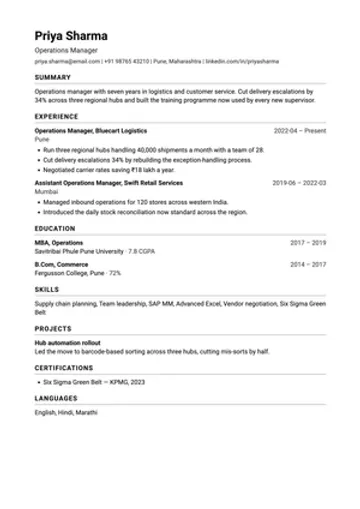
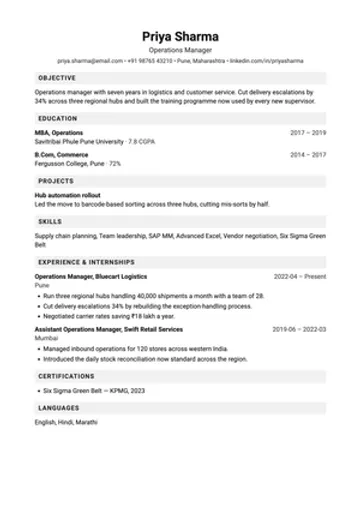
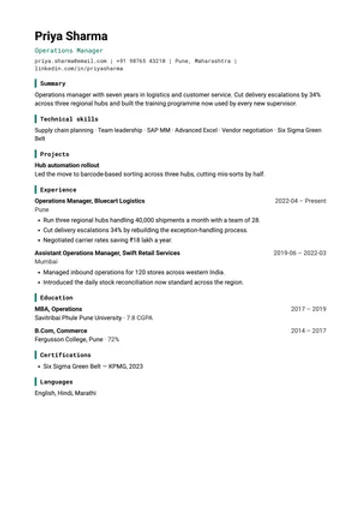
Templates that follow this format
More guides: ATS-friendly resume · Fresher resume format · Bio-data format · Spot a fake job offer · Gulf CV · Europass CV · German CV · UK CV · US and Canada resume · Government job resume · Teacher resume · Campus placement resume · Naukri resume headline · Notice period · CTC on a resume · Employment gap